Why sports production breaks newsroom systems the moment you leave the building

Large sports events no longer live in studios, but many production systems still do. When production leaves the building, coordination quietly begins to fracture, highlighting the importance of a cohesive sports production workflow.
This is the second in a four-part series on modern sports production, published in connection with a Nordic broadcaster’s 2026 Winter Olympics production on Dramatify.
Newsroom systems are among the most successful pieces of software ever introduced in broadcasting. They brought order to fast deadlines, created shared editorial spaces, and allowed large organisations to coordinate complex output reliably. That is why platforms such as AP ENPS and Avid’s newsroom management systems have become industry standards for many broadcasters.
It is also why these tools inevitably appear around sports. Sports output has to connect to editorial teams, studios, graphics, publishing and distribution, and in most organisations, those workflows are already anchored in a newsroom system and the MOS ecosystem around it.
The issue is not that newsroom systems are poor tools.
The issue is that the assumptions that make them brilliant for newsroom production become friction points when sports production turns into what it always becomes at scale: mobile, multi-venue, multi-platform, and structurally repetitive across many days, necessitating an efficient sports production workflow.
When production stops living at a desk
Large live sports productions are not studio productions with more and bigger cameras. They are temporary organisations. Understanding the intricacies of a sports production workflow is crucial for successful execution.
For weeks or months, production reality moves between venues, cities and countries. Control rooms are assembled and dismantled. Crews rotate constantly. Rights obligations reshape output priorities daily. Platforms multiply. Editorial focus shifts hour by hour.
The production system is no longer anchored to one building, one gallery, or one editorial flow. And yet many organisations still try to run this reality inside tools designed precisely for that.
The mismatch is structural, not technical
Newsroom systems are built around a stable centre of gravity: the newsroom. Even when teams work remotely, the workflow model still expects a relatively consistent editorial chain, a relatively consistent set of outputs, and a production environment where the primary planning unit is a story or a segment moving through a rundown toward publication or transmission.
Sports production is built differently.
At large-event scale, production revolves around disciplines that run in parallel, sessions as stable production units, venues that operate independently, broadcast windows that aggregate output across a day, and rights structures that redefine where content may go. The same competition may exist simultaneously as a live broadcast, a live stream, a highlights source, a VOD asset and sometimes a radio output.
This is not a variation of newsroom production. It is a different production discipline.
Where production reality first begins to fracture
The breakdown rarely looks dramatic. It begins quietly.
A schedule is exported into a spreadsheet so everyone can see it more easily. A separate planning file appears for a particular venue. Rundowns are copied between systems and teams to speed things up. Metadata and platform notes are retyped because moving them between tools is awkward.
None of this is irrational. It is the natural response when production reality becomes more complex than the system modelling it.
The cost is that the organisation gradually loses a single source of truth. Slight differences appear between versions. Then small differences become operational differences. Eventually, teams are no longer coordinating the same event, even though everyone believes they are.
This is where risk enters the system. Not through one big failure, but through hundreds of small misalignments that only become visible when the show is already live.
Mobility turns coordination into an architectural problem
In large sports production, coordination no longer happens in a single room.
Part of the team may be working on the alpine slope preparing a Super-G. Another group may be running the main broadcast from the home studio. A third team may be coordinating international output from a control room on the other side of the world, inside a stadium that exists only for the duration of the event.
All of them are working on the same competition. The same sessions. The same broadcast windows. The same editorial priorities. But they are separated by distance, time zones and infrastructure. In this environment, the first thing that tends to break is not the system itself. It is the shared understanding of what the event actually is.
Small differences appear between local plans and rundowns. A session moves, but only one team updates it. Editorial priorities change, but do not propagate everywhere. Rights constraints shift output patterns, but only part of the organisation sees the change. Over time, teams stop coordinating the same event, even though everyone believes they are.
This is where mobile production becomes more than a question of access. It becomes a question of whether the production system itself can exist across venues, studios and continents without fragmenting into parallel realities.
In Dramatify, production planning is not tied to a location. The same rundowns and schedules are accessible to teams on the slope, in the studio, and across the ocean. Live rundowns, broadcast windows and editorial structures remain connected even as execution moves between venues and control rooms. When changes occur, they propagate through the same production environment rather than creating new versions.
The practical effect is quiet but decisive. Teams spend less time reconciling plans. Coordination becomes simpler. And live production remains anchored to one shared truth, wherever the event happens.
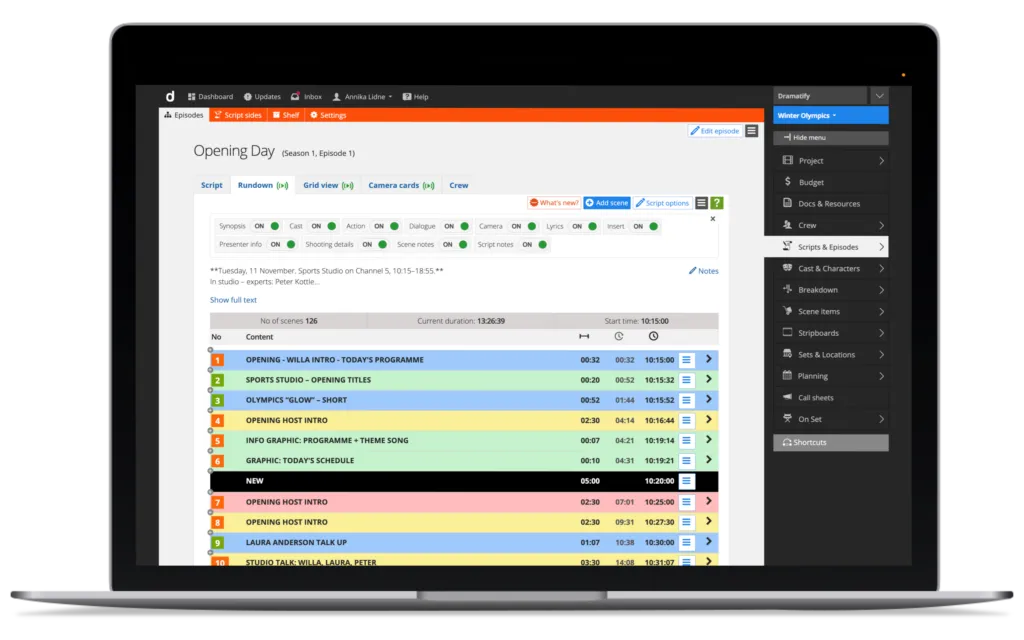 Dramatify’s rundown works across devices for planning and live broadcast.
Why schedules rarely stabilise sports production
In many organisations, there is a comforting assumption that once the schedule is locked, everything will stabilise. In sports production, this almost never happens.
Weather moves sessions. Injuries change medal prospects. Editorial focus shifts overnight. Rights obligations move content between platforms. Venues overrun. Broadcast windows change.
Schedules are not the stabilising force. They are among the most volatile elements in the entire system. If the underlying content structure is unstable, scheduling does not resolve complexity. It amplifies it.
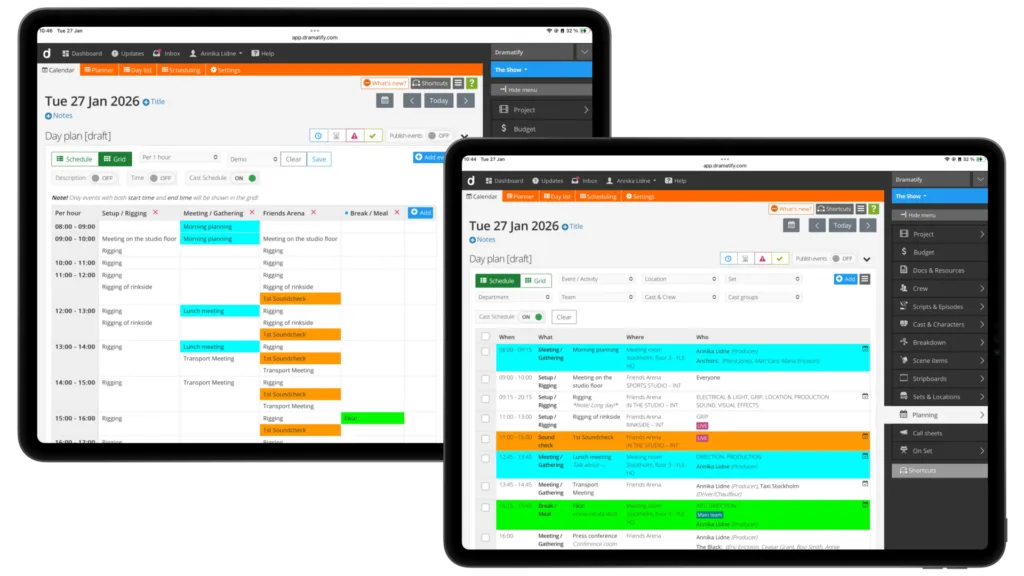
Daily, digital, integrated and personalised schedules are just one aspect of Dramatify’s sports production workflow.
Why newsroom data models cannot survive sports reality
The real limitation is not performance or interface. It is the data model. Newsroom systems are built around stories and items flowing through a linear rundown.
Sports production is built around disciplines that persist across events, sessions as stable production units, venues as temporary execution layers, broadcast windows that aggregate sessions, and rights metadata that controls distribution.
If sessions do not exist as stable entities, everything downstream becomes fragile. Rundowns drift because their building blocks are unstable. Rights data becomes unreliable because content identity is unclear. Parallel outputs lose alignment because they are no longer anchored to the same production truth.
This is not a tooling problem. It is an architectural one.
What large-scale sports production workflows actually need
At major-event scale, the sports production workflow must preserve continuity before it optimises speed.
Production teams need to keep content stable even as schedules move. They need to plan across multiple venues inside one coherent structure. They need to support parallel outputs without duplication and keep rights and platform logic attached to content rather than files. They need to reuse competition structures between championships and support temporary teams without rebuilding planning from scratch.
These are not extensions to newsroom workflows. They are the foundations of sports production.
Where Dramatify fits in this reality
Dramatify is not a newsroom system, and is not intended to replace newsroom workflows for news. Its role in sports is different.
It provides a collaborative sports production platform that models large events around stable content structures and allows distributed teams to work and broadcast from the same underlying reality, even as schedules, venues and priorities move.
Competitions, disciplines and sessions exist before locations, dates, and times are final. Broadcast windows attach to content rather than becoming empty time containers. Rights and platform metadata remain connected as production evolves. Parallel outputs inherit structure instead of duplicating it. The practical result is not visible in one dramatic moment. It appears over time.
Planning becomes easier from one championship to the next. Ramp-up time for temporary teams shrinks. Editorial continuity improves. And the organisation stops rebuilding production reality every season.
Summary
Newsroom systems remain essential for newsroom production. But large-scale sports production is no longer a newsroom problem. It is a mobile, multi-venue, multi-platform, rights-driven discipline that depends on continuity across space and time. And it requires a production architecture built for exactly that world.
Move sports production workflows beyond fixed-studio assumptions: Explore sports production workflow features built for large events.
Other articles in the series
1. Planning Olympic-scale productions: how content is structured before crews arrive
3. Replacing spreadsheets in sports production: where mistakes actually happen
4. Why Innovation-Driven Sports Producers Scale with Confidence