Why Innovation-Driven Sports Producers Scale with Confidence
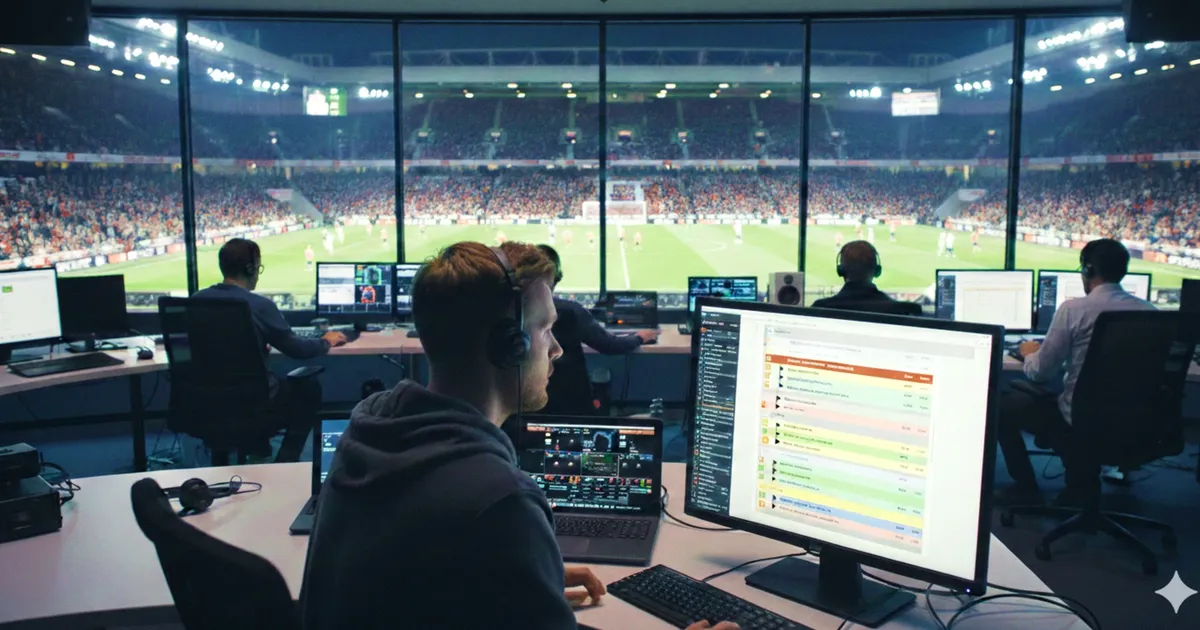
The most efficient sports producers are not faster because they work harder. They scale because they can run live sports productions from anywhere, using digital rundowns as a shared tool within a connected sports production management software system.
This is the last article in a four-part series on modern sports production, published in connection with a Nordic broadcaster’s 2026 Winter Olympics production on Dramatify.
Scaling sports production is no longer a studio problem
For a long time, sports production scaled by building stronger centres. Bigger studios. More permanent control rooms. More infrastructure in one place. That model no longer reflects reality.
Large sports productions now unfold across venues, cities and countries. Some team members may be on-site at a competition venue, others in a home studio, and still others coordinating feeds, rights, and outputs from elsewhere entirely. Production no longer takes place at the studio. It happens where the event is. Systems that still assume a fixed location begin to struggle under that shift.
Rundowns are still the essential tool for live execution
Despite all technological change, one thing has not changed. Professional live sports production still requires rundowns. They guide editorial flow, coordinate technical execution, and align teams around timing and priority. Every role, from producer to camera operator, depends on the rundown to understand what is happening now and what comes next.
The problem is not the importance of rundowns. The problem is that many rundown tools are either runs on office software or are bolted into place and do not travel. Either way, they are difficult for the crew to conveniently access on phones and tablets before broadcast and many show up unprepared.
What breaks when rundowns are tied to a place
Traditional rundowns tend to live in studios. They are printed for the gallery, shared as files, copied into spreadsheets, and updated locally. Or run on news systems that are installed at a few computers in the gallery and editing room. As long as production stays in one place, teams compensate.
Once production becomes distributed, that compensation stops working. The rundown no longer travels with the event. Updates become uneven. Execution logic fragments between locations. Coordination does not collapse dramatically. It becomes quietly harder, slower and more fragile.
What innovation-driven sports producers do differently
Innovation-driven producers change one fundamental assumption. They treat rundowns as part of the sports management production system software, not as standalone documents or on a handful of terminals in the gallery.
Rundowns become digital and live. They are accessible on any device. They can be used on site, in the studio, or remotely–even at home or in a hotel room. The same rundown supports the team at the venue, the editorial team elsewhere, and the technical team running the broadcast. Everyone works from the same execution logic, even when they are not in the same room.
This is not about replacing studios. It is about allowing live production to travel with the event.
Digital rundowns inside a sports production management software system
The real difference appears when digital rundowns are not only mobile but also connected. In modern sports production management software systems, rundowns sit inside the same structure as production planning. They connect to people, assets, locations and schedules rather than existing as isolated lists. That means execution decisions are no longer separated from production reality.
When teams move between locations, the rundown moves with them. When production expands across sites, execution stays aligned. When events repeat, teams do not start from zero. The system carries structure forward instead of forcing teams to recreate it.
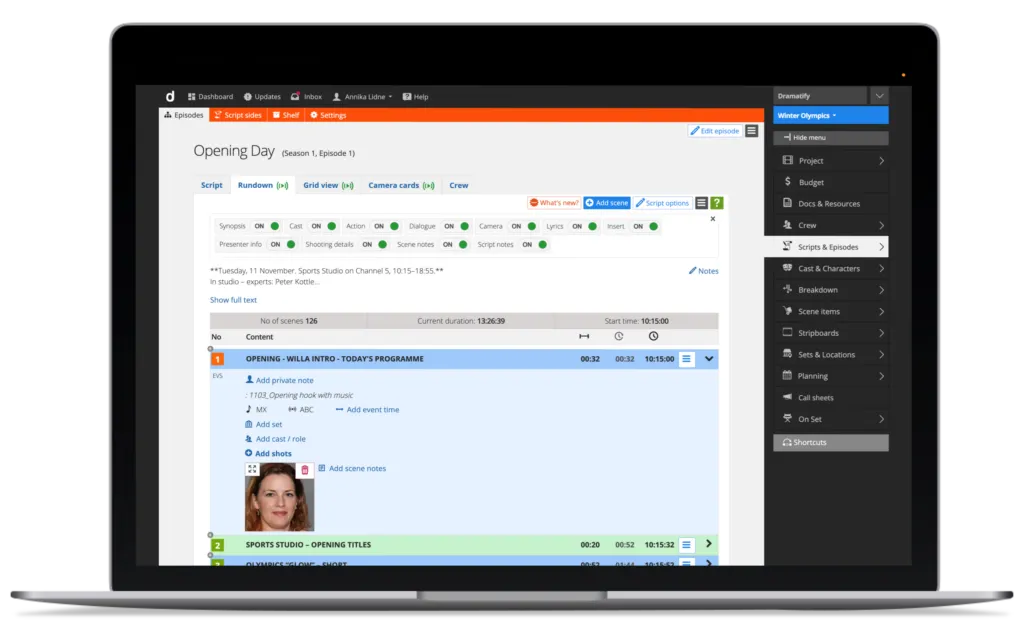
The outcome: efficiency, output and confidence at scale
This shift produces results that compound over time. Teams ramp up faster. Coordination costs drop. Execution becomes calmer. More output is produced with the same resources.
Most importantly, producers gain confidence that live execution will hold together even as scale increases and production becomes more distributed. Not because change disappears. But because the system is built to absorb it.
Summary
Innovation in sports production is no longer about adding more infrastructure. It is about smarts: making live production mobile, without losing control. When sports producers run live productions using digital rundowns inside an integrated production system, they stop rebuilding for every event and start scaling with confidence.