Planning Olympic-scale productions: how content is structured before crews arrive

Large sports events are no longer decided on the day of broadcast. They are decided months earlier, in how content is structured before scheduling and logistics lock in.
This is the first in a four-part series on modern sports production, published in connection with a Nordic broadcaster’s 2026 Winter Olympics production on Dramatify.
Large sports events do not fail because trucks arrive late or cameras are missing. They fail much earlier. They fail when content structure collapses under scale, long before logistics, crews, or schedules even come into play.
At the Olympic scale, production is no longer about running one show well. It is about managing thousands of interconnected editorial decisions across disciplines, sessions, broadcast windows, platforms, and days, without losing coherence.
And that challenge begins long before the first rundown is drafted.
Sessions (individual competition blocks such as matches, heats, or a morning athletics blocks)
When logistics come first, content pays the price
Most sports productions still begin with operational planning:
- Venues.
- Dates.
- Sessions.
- Crews.
- Broadcast windows.
All of this matters. But none of it defines what the audience will actually see.
What drives live sports production is not logistics. It is content structure: Which competitions exist. How sessions are grouped. Which events belong to which broadcast windows. How disciplines flow across days. How editorial priorities shift between platforms.
When this structure is not explicitly modelled early, everything downstream becomes fragile. Rundowns drift. Metadata fragments. Rights information becomes unreliable. Parallel broadcasts and streams lose alignment.
By the time production teams realise this, the schedule is already locked, and the only option left is firefighting.
Why Olympic-scale production breaks traditional planning models
At the scale of a Winter Olympics or a world championship, production is no longer linear.
You are dealing with:
- 16 disciplines across 8 sports
- 50 events for women and 54 for men
- Hundreds of sessions
- Multiple venues in parallel
- Several broadcast channels
- Streaming, highlights, VOD and radio outputs
- International rights structures
- Editorial priorities that change daily
Spreadsheets collapse under this complexity. Documents multiply uncontrollably. Rundowns become isolated islands.
And the most dangerous thing happens quietly: Content identity disappears.
Sessions are renamed. Competitions are regrouped. Broadcast blocks shift. Editorial focus moves. But the underlying content model is never stable. That is where mistakes are born.
The missing layer: content planning before scheduling begins
The biggest structural gap in sports production today is not better scheduling. It is the absence of a persistent content planning layer.
Before crews, before logistics, before call sheets, production organisations need:
- A navigable model of the entire event
- Stable identities for disciplines, sessions and competitions
- Editorial grouping independent of venues and dates
- Reusable structures across days and outputs
- Metadata that survives schedule changes
This is where modern sports production planning actually starts. Not with people. With content.
How large sports events are structured in Dramatify
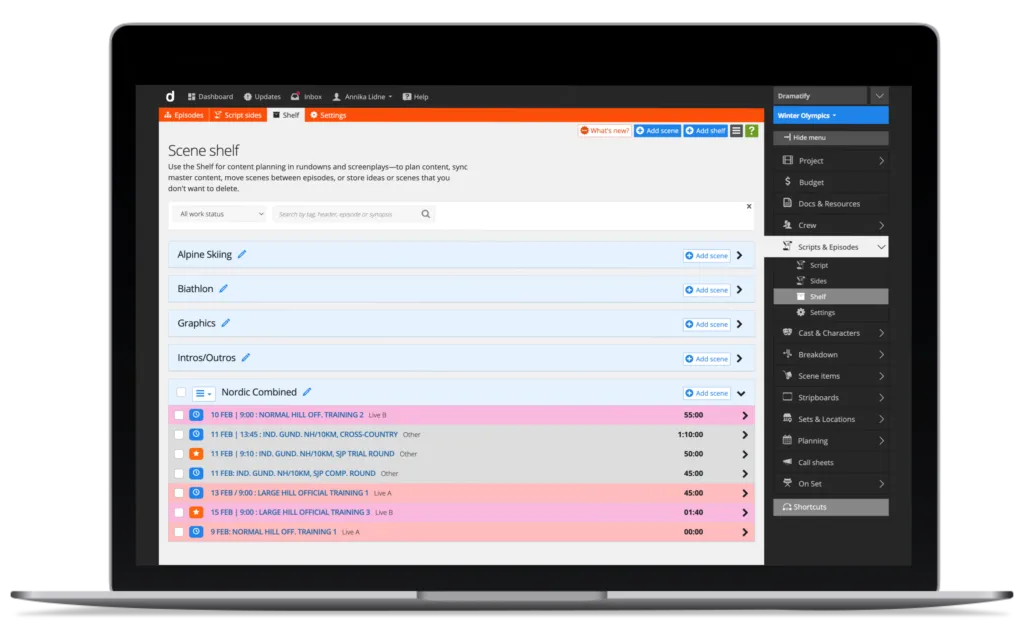
In Dramatify, large sports events are first built in The Shelf.
Not as documents. Not as decks. But as a structured content universe.
For an Olympic-scale event, that means:
- Planning starts almost a year before broadcast when no competition schedules exist
- One master content model of the entire competition
- Disciplines, events and competitions organised and tagged
- Sessions grouped into editorial blocks
- Broadcast blocks mapped to content, not just time
- Direct flow between content planning and rundowns
This allows production teams to:
- See the full editorial structure months in advance
- Reuse competition structures across multiple outputs
- Keep identities stable even as schedules move
- Align planning across sports, broadcast, streaming and highlights
And, most importantly, preserve content truth while everything else changes.
When content structure exists, scheduling becomes safer
Once content is modelled first, logistics becomes dramatically more reliable.
Because now:
- Schedules attach to stable content entities
- Rundowns inherit editorial structure
- Metadata follows sessions automatically
- Rights and platform data remain correct
- Parallel outputs stay aligned
Instead of fighting change, production systems absorb it. Instead of version conflicts, teams get controlled evolution. This is the difference between planning around time and planning around meaning.
At the Olympic scale, that difference determines whether production stays in control.
The real advantage is not speed. It is continuity
The quiet breakthrough in modern sports production is not faster scheduling. It is continuity across events.
When disciplines are reused, session structures are reused, broadcast blocks are templated, metadata models persist, and workflow knowledge accumulates, every new championship becomes easier than the last.
Not because the event is simpler. But because the organisation is no longer rebuilding production reality from scratch.
Why this now matters more than ever
Broadcasters today are facing:
- Denser sports calendars
- More platforms per event
- Fewer staff
- Tighter budgets
- Higher editorial expectations
The organisations that will survive this decade are not the ones with the best individual tools. They are the ones that can carry production intelligence forward, reuse content structures, stabilise editorial truth, and reduce organisational memory loss.
At large-event scale, this is no longer an optimisation. It is operational survival.
Planning Olympic-scale productions is no longer about controlling logistics. It is about controlling content structure early enough that logistics never has the chance to break it. That is where modern sports production planning now begins.
👉 Plan large-scale sports content before scheduling begins: Explore sports production planning software built for major events
Other articles in the series
2. Why sports production breaks newsroom systems the moment you leave the building
3. Replacing spreadsheets in sports production: where mistakes actually happen
4. Why Innovation-Driven Sports Producers Scale with Confidence