AI Show Development That Drives Commission Wins
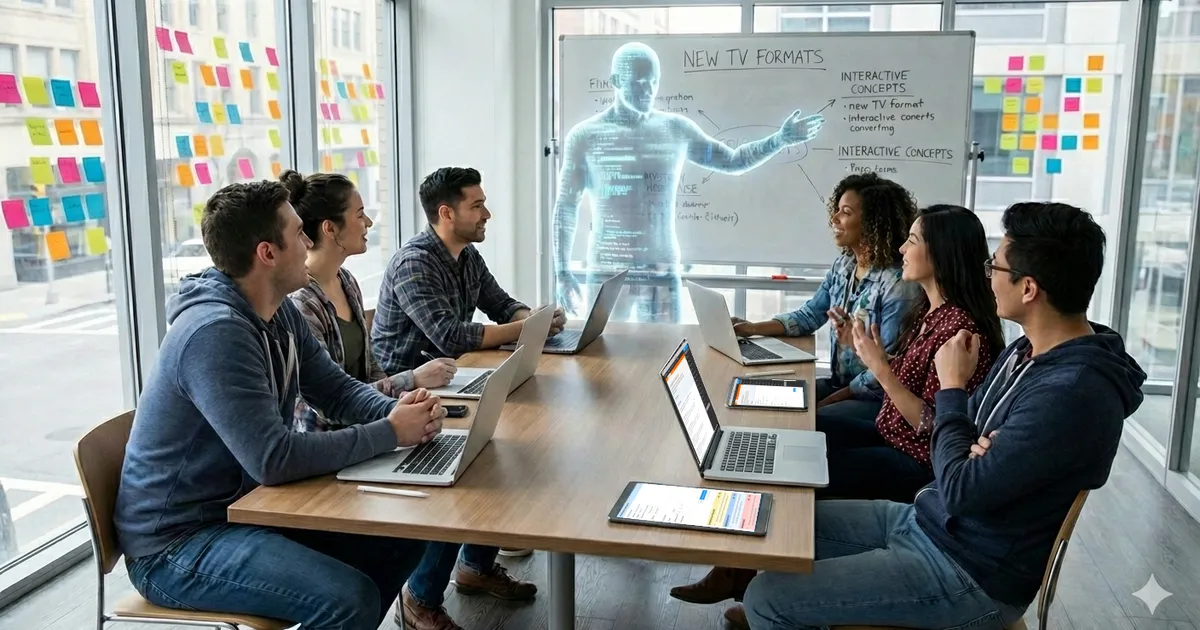
Without development, production companies don’t have a business. New ideas and formats are the lifeblood that leads to commissions, and commissions lead to production income. Dramatify’s AI show development features change the economics of this phase by helping teams generate a larger pool of targeted ideas faster, aligned to broadcaster needs and schedule slots, reducing risk and wasted spend.**
Why development can’t slow down
Without development, production companies don’t have a business. New ideas and formats are the lifeblood of the entire operation. They are what lead to programme commissions, and programme commissions generate production income. When development stalls, the pipeline stalls. When the pipeline stalls, the company is exposed.
That is why the economics of development matter so much. Development is necessary for future revenue, but it is also one of the least visible and most financially risky phases in entertainment production.
Development costs are no longer marginal
In today’s market, development is not a small upfront investment. Production companies are expected to present more ideas, in more variations, and with clearer alignment to channel strategy and audience needs to a lower budget than before. Broadcasters want concepts shaped for specific slots, durations and scheduling realities much earlier than before.
The result is that development costs quietly grow. Over time, they can reach levels that materially affect a company’s stability. If a company carries too much development risk for too long, the consequences can be severe.
What AI actually changes in development
AI does not replace creative judgement. What it changes is the speed and scale at which ideas can be explored and structured.
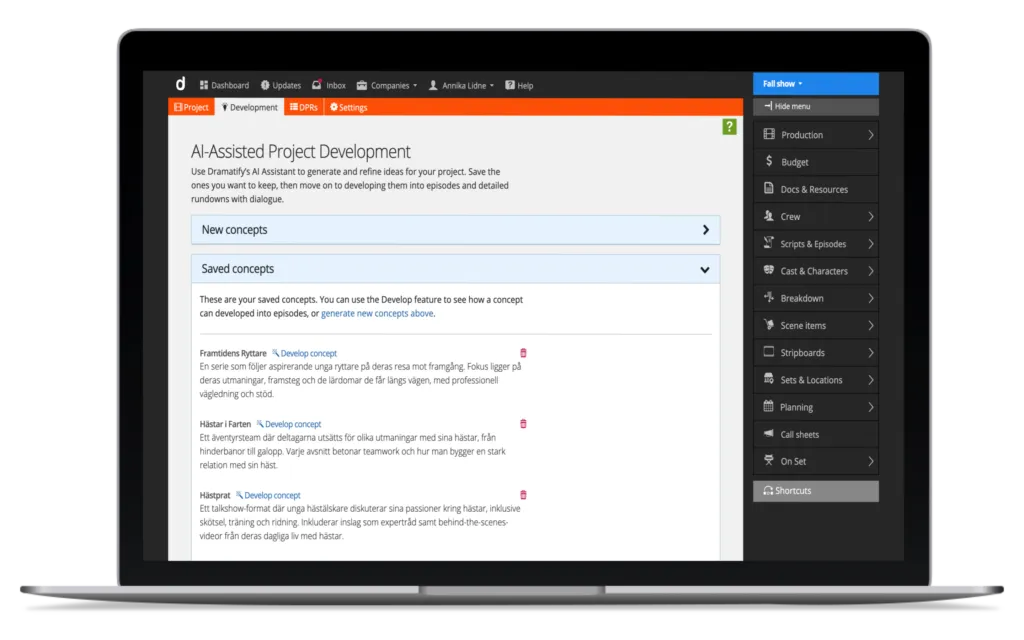
With AI-supported show development, producers can rapidly generate and compare multiple concept directions from a single starting point. A raw show idea can be expanded into alternative angles, synopses. episode approaches and segment concepts in a fraction of the time traditional development requires.
This allows teams to move beyond a small number of heavily worked ideas and instead build a broader, more targeted pool of concepts for final selection.
From fewer bets to a larger, better-aligned slate
One of the biggest risks in development is concentration. When development is slow and expensive, teams are forced to place large bets on a small number of ideas. If those ideas miss the broadcaster’s needs, audience strategy or schedule requirements, the investment is largely lost.
By accelerating ideation and early structuring, AI show development makes it possible to explore more options at lower marginal cost. Concepts can be tailored to specific broadcasters, genres and time slots early, before significant resources are committed. That increases the chances of alignment and reduces the cost of being wrong.
Broadcasters don’t commission ideas in isolation
Broadcasters commission shows that fit a schedule. They need formats that work within a slot length, a production rhythm and a broader audience strategy. A strong idea that does not fit these constraints often fails, regardless of creative merit.
AI-supported development makes it easier to shape ideas with these realities in mind. Episode length, pacing, recurring segments, and the balance between live and pre-produced elements can be explored early, long before a pitch deck is finalised.
This turns development into a more precise and less speculative process.
Why integration matters
The real financial impact appears when AI development is integrated into a production system rather than treated as a standalone tool.
When early concepts, episode outlines and segment ideas live in the same environment that later handles planning, rundowns and execution, development work does not disappear after a pitch. It carries forward.
Ideas evolve into structured planning. Early assumptions can be tested against production constraints. Work is reused instead of recreated. Waste is reduced without narrowing creative ambition.
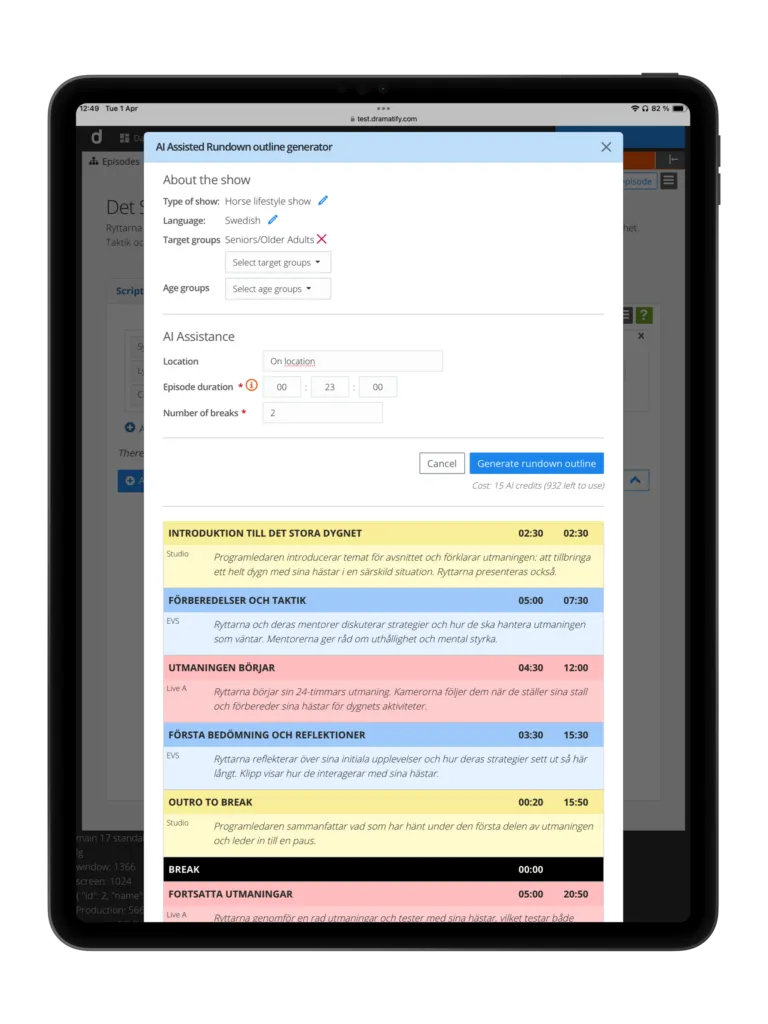
Dramatify’s AI show development tools span ideation concepts, episode synopses, and outline drafts to final content in 59 languages.
The economic impact
Used at scale, this approach can save production companies and broadcasters millions in development costs. Not through automation alone, but by changing the economics of development itself. More ideas can be explored in less time. Fewer are over-invested in too early. Alignment improves before money is spent.
In a market where development determines whether a company has future commissions, that shift matters.
AI show development enhances creativity, not removes it.
AI show development is not about generating finished programmes, downsizing development departments, or removing the creative decisions from humans to AI. It’s about giving seasoned professionals the tools to generate more ideas in less time, then use their skills, creativity, and professional judgement to develop those ideas into high-quality programme ideas and pitches, while AI provides tools, fast outlines, and sample dialogue.
It is about keeping the development pipeline moving, reducing risk, and building stronger slates that are better aligned with broadcaster needs and scheduling realities.
Without a strong slate, there are no commissions. Without commissions, there is no production income. That is why development speed and quality have become a business-critical capability, not a creative luxury.
Part 1 of 6 — Entertainment Production Series
 1
113 Feb 2026
AI Show Development That Drives Commission Wins
Reading now 2
217 Feb 2026
Entertainment Production Workflows Beyond Spreadsheets
 3
324 Feb 2026
Why Digital Entertainment Rundowns Don’t Break Live
 4
43 Mar 2026
The Innovative Shift in Live Entertainment Rundowns
 5
56 Mar 2026
5 Proven Eurovision Qualifier Production Lessons
 6
613 Mar 2026
5 Powerful Entertainment Rundown Templates That Scale Shows
 7
715 Apr 2026
Proven TV Format Production That Cuts Costs at Scale
 8
825 Apr 2026
The Powerful Talent Show Production Workflow Behind Hit Formats
 9
99 Jul 2026
Inside Reality Show Production Workflows